
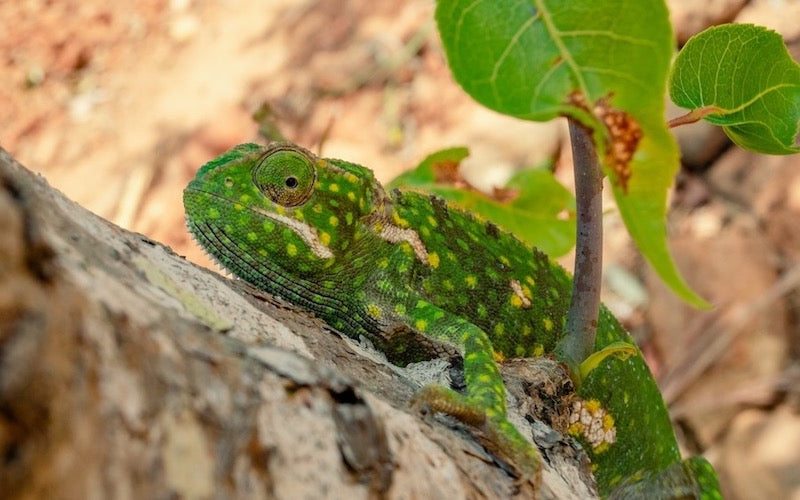
Where do chameleons live? Chameleons are a diverse species of lizard that live in Africa, Madagascar, and parts of Asia, the Middle East, and Europe. Depending on the species, chameleons may be found in the tropics and sub-tropics, scrub savannas, and even the desert.
The majority of chameleon species are found in Africa and Madagascar, with nearly half of all chameleon species originating from Madagascar.
Where Do Chameleons Live?
If you’re like most people, when you think of a chameleon’s habitat in the wild, you probably picture lush and dense tropical rainforests.
And for the most part, you’d be correct!
- Nearly half of all chameleon species – 44% to be precise – originate from the rainforests and subtropics of Madagascar.
- Other chameleon species live in the scrub savannas and rainforests of Africa and the subtropics of India.
- There are some chameleon species that live in the southern portions of Spain and Portugal, and there is even a species that lives in the deserts of the Middle East.
So, where do chameleons live? With such a diverse species that includes over 200 different types of chameleon, it’s no wonder that they can be found in almost every type of warm environment, from rainforests to deserts.
Where Are Chameleons From?
As cold-blooded creatures, chameleons thrive in warmer climates, with the vast majority of chameleon species preferring the more humid climates of the rainforest and subtropics. They are most commonly found throughout the African continent and on Madagascar, where conditions are perfect for them to thrive.
Chameleons on Madagascar
Nearly half of all chameleon species originate from Madagascar, including some of the most popular chameleons to keep as pets. The world’s largest chameleon species – the Parson’s Chameleon – and the world’s smallest chameleon species – the Nano-Chameleon – both originate from Madagascar. Other well-known species from Madagascar include:
- Oustalet’s Chameleon
- Panther Chameleon
- Carpet Chameleon
- Nosy Hara Leaf Chameleon
- O’Shaughnessy’s Chameleon
This is just a small sampling as Madagascar is home to between 90 and 100 different chameleon species.
Chameleons on the African Continent
The African continent is huge and boasts a variety of climates and environments, making it a perfect chameleon habitat. Although not as many species of chameleons are native to Africa as to Madagascar, there’s still plenty of variety.
African chameleon species include:
- Jackson’s Chameleon
- Senegal Chameleon
- Flap-Necked Chameleon
- Strange-Horned Chameleon
- Four-Horned Chameleon
The Jackson’s Chameleon is a popular pet. It’s been introduced into the wild in Hawaii, Florida, and, to a lesser extent, parts of California. They are considered invasive, especially in Hawaii.
Chameleons in India
Commonly referred to as the “Indian Chameleon,” chamaeleo zeylanicus can be found throughout select regions of South Asia, like Sri Lanka and Pakistan, in addition to being found throughout India.
Chameleons in Spain and Portugal
One doesn’t typically associate Europe with chameleons, but the truth is there are two known chameleon species native to southern Europe, particularly Spain, Portugal, Italy, Cyprus, and Crete.
- The Common Chameleon is also often referred to as the Mediterranean Chameleon. In addition to southern Europe, this chameleon species can also be found in North Africa and parts of the Middle East.
- The African Chameleon, also called the Sahel Chameleon, is native to North Africa, but can also be found in Greece.
Chameleons in the Middle East
Originating from the Arabian Peninsula, the Veiled Chameleon is the only chameleon species native to the Middle East. It’s also one of the most highly-sought species of chameleon to keep as pets. As with Jackson’s Chameleons, Veiled Chameleons have been introduced into the wild in Hawaii and are considered an invasive species.
Do Chameleons Live Anywhere in the U.S.?
Given that the U.S. is such a large country, and that the American continent boasts such a variety of climates, you may be wondering if there are any chameleon species that are native to the U.S.
Perhaps you’ve heard of the “American Chameleon?”
Don’t be fooled by the name. The so-called “American Chameleon” gets this misnomer from the fact that it has limited ability to shift colors from brown to green. But that’s where its similarities to real chameleon species ends.
The American Chameleon—which is actually a Green Anole—can be found in parts of the southern United States, particularly the Carolinas, Florida, and Texas. It prefers to live in brush and shrubs, but can often be seen on fences and walls.
However, although there are no chameleon species that are native to the Americas, the United States does have chameleon species that have been introduced into the wild. These chameleons either escaped their enclosure, were released by their chameleon keeper, or hitchhiked a ride on trees imported from places like Africa and Madagascar.
The environment in places like Florida, Texas, Hawaii, and even parts of California have proven stable enough for chameleons like the Jackson’s Chameleon and the Veiled Chameleon to adapt and even start breeding. Since they have no natural predators in the U.S., these chameleon “camps” have been able to thrive in the wild.
Since chameleons are considered invasive, efforts are being made to remove them from the wild. However, this has proven difficult as the only humane way to remove them is to capture them one-by-one. Herpers – people who search for amphibians and reptiles – rescue these chameleons and bring them back to captivity.
Takeaway: There are over 200 species of chameleon coming from a diversity of environments. Nearly half of chameleon species come from Madagascar, with other species coming from Africa, India, the Middle East, and even southern Europe.
FAQ
Where Do Panther Chameleons Live?
Panther Chameleons are the largest species of chameleon and originate from Madagascar.
Where Do Veiled Chameleons Live?
Veiled chameleons live in the Middle East, particularly Yemen and Saudi Arabia. They have been introduced into the wild in Florida and Hawaii, and are considered invasive.
Where Do Jackson’s Chameleons Live?
Jackson’s Chameleons are originally from the African continent. They are a popular species among chameleon keepers, and have also been introduced into the wild in Florida, Hawaii, and other parts of the southern United States.
Do Chameleons Live Anywhere in the U.S.?
There are no chameleon species native to the U.S. The so-called “American Chameleon” – the Green Anole – is often confused for a chameleon because of its limited color-changing abilities, but it is not.
There are, however, non-native species of chameleons, like the Jackson’s Chameleon and the Veiled Chameleon, that have been introduced into the wild in places like Florida, Texas, and Hawaii.